
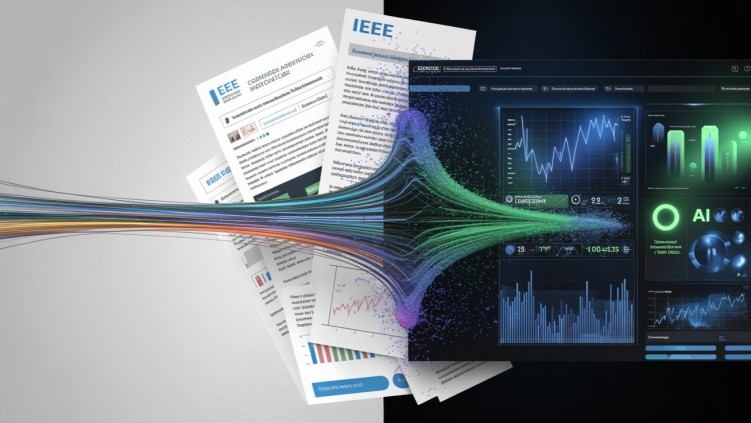
Research becomes truly valuable when it solves real problems.
In my work across artificial intelligence, financial technology, and applied data systems, I believe research should extend beyond academic settings. Its true value emerges when it leads to practical systems that improve decision-making and translate into measurable business impact.
This process guided my transition from academic research to applied financial technology.
My research has been presented at international IEEE conferences, including IMCOM 2026 and ICAIII 2026, where I worked on topics such as digitalisation, entrepreneurial engagement, and determinants of FinTech adoption using large-scale financial datasets and regression modelling.
These studies examined how digital access, financial inclusion, and socio-economic factors influence financial behaviour and technology adoption across developing economies.
I also conducted research on machine learning applications for fraud prevention in Pakistan’s banking sector, demonstrating how AI can enhance fraud detection and financial monitoring beyond traditional rule-based systems.
These projects were more than academic exercises.
They formed the foundation for real-world systems.
Insights from these studies directly informed the development of Fasai.uk, my independent AI-powered financial intelligence platform for fraud detection, credit risk modelling, investment analysis, and explainable decision-making.
Rather than building isolated machine learning models, I developed systems that combine predictive power with transparency and governance. This involved integrating models such as Random Forests and XGBoost with explainability frameworks, including SHAP, LIME, and counterfactual methods. The result is not only improved prediction accuracy, but also systems that users trust, auditors can verify, and organisations can deploy with confidence. This research-to-reality approach also guided my work with organisations such as Union Stores, Noor Brands, and DevCraft, where AI systems were implemented to enhance fraud monitoring, operational control, and decision-making.
Academic research provided the theoretical foundation.
Real business environments have tested these concepts in practice.
Both are necessary.
For me, innovation is not defined by publishing a paper. It is when research leaves the page and begins to create measurable value.
That is where real impact begins.